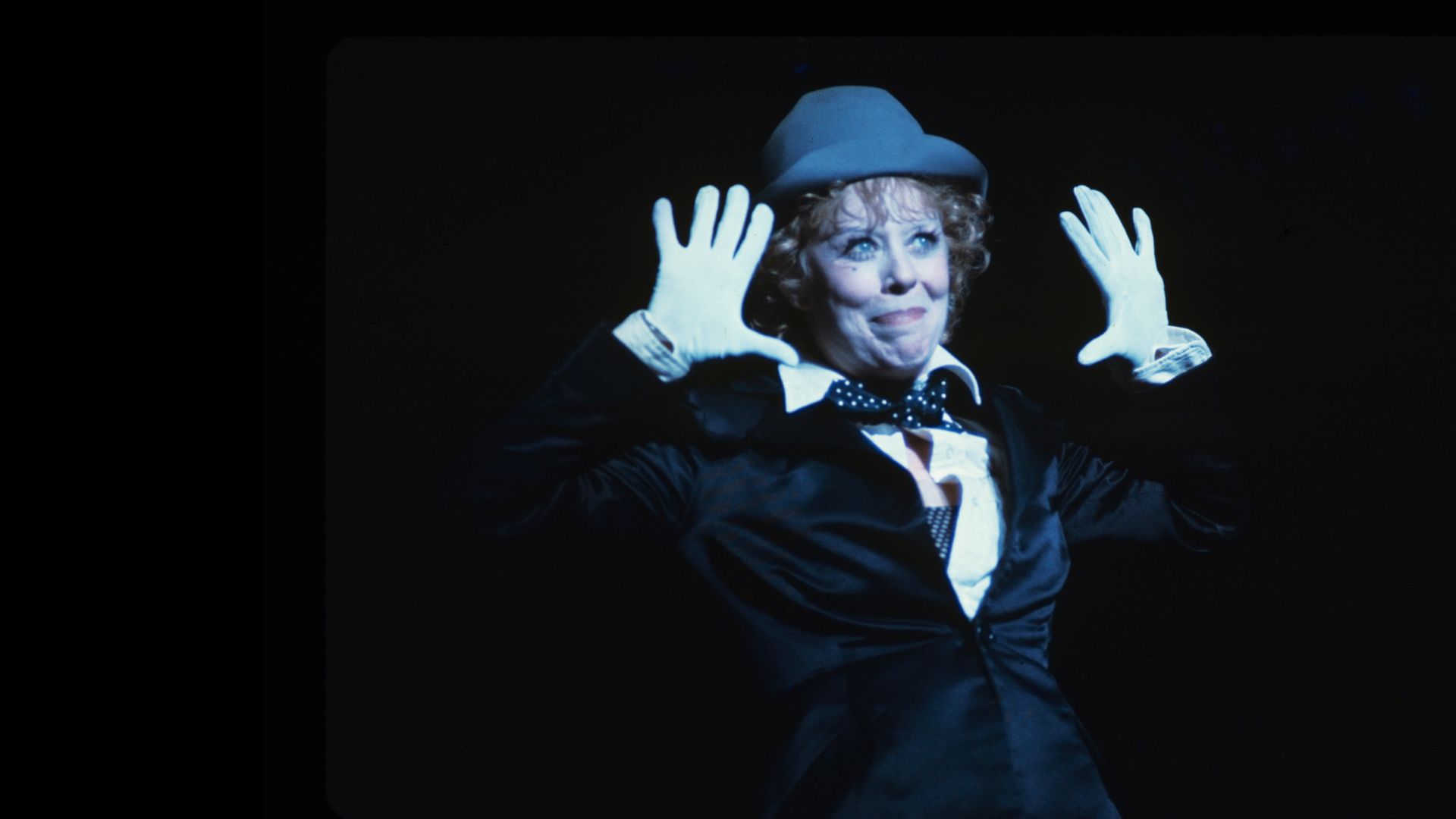
Ladies and gentlemen! We proudly present Broadway’s great dance star: the one, the only, Gwen Verdon, in our opening number, Who’s Got The Pain, from the movie Damn Yankees! She’s partnered by the show’s choreographer, Bob Fosse, who was her partner/promoter/husband/the whole catastrophe. Back when the show was first on the way to Broadway, they quickly concocted this little fill-in number from their shared background in low entertainments.
Fosse’s good if you could take your eyes off Verdon, but who would? She had total command of technical competence learned slow and hard, a unique voice (singing and speaking), and she won a Tony for her acting. She acted IN the dancing. Talk about triple threat. And, like the greatest ballerinas, she radiated charisma. She draws you still.
And here’s the jankiest clip in our tribute – Verdon makes it worth the watch. She’s performing Fosse’s choreography on the Bob Hope Show on television in 1968, in the afterglow of her 600-plus Broadway performances in Sweet Charity. These are mini-numbers from a classic divertissement, a culmination of a style of dance she helped create and perfect. The whole is a cultural mood – Mexican, cowboy, 1960s laidbackness – expressed in exacting, exact, tiny motions. Who could ask for anything less?
Verdon came into life bang on the beat of the moment, and found her metier as soon as she could walk, though walking had been a problem. She was born in Culver City, Los Angeles, to a studio technician father and a mother who’d danced in the early modern Denishawn company. Baby Verdon had had rickets, meaning bowed legs, for which the remedies were orthopaedic boots; her mother avoided the ultimate treatment, breaking and resetting leg bones, by dancing with her daily, reversing ballet positions with toes inward, knees bent, so muscle and ligament would reform her skeleton. Verdon learned Spanish dancing from the Cansino family patriarch, and tap, acrobatic, ballroom and ballet from star-teacher Ernest Belcher – though, she sighed, she never managed that extended long line of the art. Mentally her knees stayed bent, she would never pass as a princess or swan.
‘Verdon could grasp every move after a single demo’
And certainly not as an innocent village maiden. At 17, she was pregnant by her parents’ friend, gossip columnist James Henaghan, and mom and pop insisted on marriage. Henaghan was a drunk; she supported baby Jim by selling horsemeat in a pet food store until she was old enough to tap in a movie chorus line. Nothing was going anywhere until she saw the touring cabaret show of Jack Cole, the pioneer of show dance. He was a genius synthesist: ballet plus modern plus African, dancehall African-American, Afro-Caribbean, Latin-American and subcontinental Indian – letting them flow into each other, an American urban folk dance. Verdon went backstage and asked if she could join the troupe if she got back in shape?
Young Jim was parked with his grandparents, and she did. Cole’s troupe were his human experimenters in class every day, in full sari rehearsing their mudras to sitar accompaniment. or trying out Watusi moves to the jazz drum number, Big Noise From Winnetka. Verdon, who could grasp every move after a single demo, rose to be Cole’s assistant, especially in his movie work, so we have tantalising scraps of what they came up with for themselves together.
Here, pouring scalding sexuality on a stone-cold Biblical epic.
Verdon, with another Cole assistant, Carol Haney, put on Gene Kelly’s shoes to splash in pans of water as the tap dub for the Singin’ in the Rain soundtrack, and she coached Marilyn Monroe to move less louchely. She also tried out for Broadway in shows that closed out of town, or soon after arriving, until Cole Porter’s Can-Can, in 1953. This had a French songster lead, with Verdon as laundry girl Claudine. Her sultry Apache dance and Garden of Eden ballet, as Eve after the apple bite, choreographed by Michael Kidd, won a seven minute ovation – Kidd had to fetch her, only partially towel-wrapped, from her dressing room to take a revealing bow. Verdon also got a Tony Award.
‘Watch her Damn Yankees! numbers and catch the pervading sadness behind her comedienne gifts’
Star status came with Damn Yankees! in 1955. Verdon had met Bob Fosse when he auditioned for a Broadway chorus; after a trial in Hollywood, he choreographed The Pyjama Game, with Verdon’s friend Haney in his revolutionary Steam Heat routine. Producer George Abbott wanted Verdon for Lola, who sold her soul to the Devil for youth and beauty, works as his chief temptress and is tasked with seducing a naïve baseball player through an imperious tango, Whatever Lola Wants. Fosse worked out the number’s every move before showing it to Verdon, and then let her into its secret joke – he envisioned Lola as a flirty little girl. A flirty FAT little girl. Verdon kept that in mind and recalled that matinee ladies who hated hot stuff loved it.
Watch her Yankees numbers and you catch the pervading sadness behind her comedienne gifts. Fosse choreographed New Girl in Town in 1957, a musical version of the ultimate sadder but wiser girl tale, Eugene O’Neill’s Anna Christie, about a whore returning home for a last shot at happiness. Verdon wanted to prove her triple threat status, that acting in musicals was real acting, could rise to tragedy. She let it all hang out, including herself from her corset when carried upstairs upside-down in a brothel dream ballet. Only a sample snippet survives – her redemption dance, proud as a showpony (16 minutes and 18 seconds in).
It led to another Tony (this time for best actress in a musical), and then another for Fosse’s Redhead (1959), a musical period murder mystery, in which you glimpse how she was by nature a character player with roots in silent comedy, despite the sexy-star image on the Yankees! posters.
‘What Verdon does in “If My Friends Could See Me Now” is assoluta level’
Verdon married Fosse in 1960; they had an unexpected daughter, Nicole in 1963, and that might have been the end for a dancer. But Fosse had been persuaded to see Fellini’s 1957 Nights of Cabiria, a goodhearted heartbreaker of a film about the misadventures of a vulnerable tart; cleaned up into Charity Hope Valentine, a Times Square dancehall hostess for hire, she was a good fit for Verdon’s accrued stage persona, more sad than wise. He sent her off to Bloomingdale’s to observe cosmetic counter salesgirls suffer standing all day in high heels, to Central Park to watch young hippies writhing their legs in knots, and in Sweet Charity (1966), at 41, she was professionally tremendous yet painfully fresh.
What’s she doing, emotionally as much as physically, in If My Friends Could See Me Now is assoluta level – you can record those steps and transfer them to another, better than competent, dancer (Shirley MacLaine for the movie, as Verdon was deemed too old), but the spirit/body interchange which animates the whole can’t be replicated. Fosse appreciated and used Verdon’s deficiencies, the knock knees and turned-in toes, made them Charity’s strengths.
Verdon found herself a fitting follow-up in a 1929 play, Chicago, but in the years it took her to get the rights, the couple split, and Fosse’s dance tone, and Broadway musical subjects, darkened. So her last stage role in 1975, as Roxie Hart, the ambitious murderess, was definitive Fosse – a hard summary, easily delivered, of all the showbiz she’d passed through, helped to create.
In the 1970s she helped form the American Dance Machine, which collected and filmed old choreographies (many were in Verdon’s own mind and muscles) to legalise their choreographers’ copyright. Verdon died in 2000; nowadays, the Verdon/Fosse Legacy organisation licences performances of their works (nobody has ever determined who originated what), including the Sweet Gwen Suite, made from her telly show numbers. (One of those, Mexican Breakfast, inspired Beyoncé’s Single Ladies routine.)
Here’s our finale, with Chita Rivera in Chicago. Sorry for the janky film, but you can still feel her power. Who could want for anything more?
Bonus Tracks
Gwen Verdon and a short history of Broadway dance
‘You don’t have to work so hard’: Gwen Verdon and Debbie Allen
Veronica Horwell is a writer for the Guardian among other publications.